|
Straylight- Territories
Haluk Akakce(Turkey), Desperate Optimists(Ireland), Külli
K. Kaats(Estonia), Paul Rowley(Ireland) + David Philips,
Eyal Sivan(Israel) and Michel Khleifi(Palestine).
Straylight- Territories brings together the work of a
diverse range of international artists whose concerns
are both divergent and specific. Notions of space be it
psychological, socio-political, geographical or abstract
are explored variously by the artists and filmmakers respectively.
Haluk Akakce’s abstract video works explore
minimalist territories that appear to expand beyond the
boundaries of the screen. Temporarily they are loops with
no particular start or end, offering transitions from
one scene to the next without emphasis being placed on
the order of the scenes. In Black on White White on Black
these minimalist spaces give way to organic forms that
appear to be seedpods that float weightlessly in space
suggesting ideas of growth and cultivation of these abstracted
territories. A tension exists between the seemingly mathematical
almost clinical spaces and the transition to organic form
that too has been created digitally with logarithmic precision.
The work unfolds at a meditative pace creating a temporal
territory for the viewer to slowly absorb its forms.
The Desperate Optimists’ 3 channel video
Wire Crossing is a chronicle of a city over the course
of one day. Filmed in real time
over 24 hours Christine Molloy and Joe Lawlor (desperate
optimists) are
joined by a diverse range of invited local Singaporean
artists to cover
the terrain. We follow 24 narratives (each one hour in
duration) the sum total of which offer a unique portrait
of a city. There is a fine
tradition in avant-garde and experimental film-making
of turning the
camera upon the city. Man With A Movie Camera (1929),
Berlin - Symphony Of A City (1927). It's as if film-makers
at that early stage in cinema
history saw that this new technology was the ultimate
tool for capturing the rhythms, textures and intensities
of modern, industrial life in an urban environment. Wire
Crossing offers a contemporary take on recording the kinetics
and diversity of space and action in a city.
Külli K. Kaats installation Avifauna
explores call and response in a new language of sounds
and noises that have been gleaned from careful observation
of the communicative enunciations of the bird kingdom.
She has composed a symphony of refrains, in a scene set
at night, that play through phases in a multi-channel
video installation. The refrains sing to an oversized
observing eye that peers back at source of the calls.
The voices pierce the night as her head emerges from the
gloom calling out with chirps, hoots and whistles, as
if asking the overseeing eye to whom does this territory
belong. Kaats creates an animist language that questions
the delimiting boundaries of human communication in relation
to the language of our distant cousins the birds. The
birdsong can be read as a metaphor for encounters with
any culture that is new, alien or different, Avifauna
suggests the lengths of transference and deferral required
in order to come to understanding with that which is other.
In trying to understand the language of the birds Kaats
must become almost birdlike.
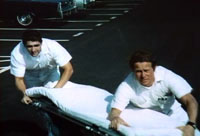
Paul Rowley and David Philips’ Security
Fugue is a two channel video installation with audio.
Contrasting the promise of rescue with threats of captivity
and injury, Security Fugue examines personal responses
to crisis in the current arena of ubiquitous security.
Images of a rescue helicopter move across the screen in
exaggerated slow motion, while on a second screen, the
camera tracks over aeriel views of a hospital and rescue
crew on the ground below. In the audio track, stuttering
confessions and dislocated murmurs echo in unison with
the constant rhythm of chopping helicopter blades which
fills the space.
Musically, the imitative polyphonic compositional
structure of the
fugue in which a theme is stated successively in several
voices is used
both to determine the editing structure of the work and
for its
references to pursuit and flight. In psychiatry, the fugue
is described
as a condition of pathological amnesia during which one
is apparently
conscious of one's actions, but has no recollection of
them after
returning to a normal state. This condition, usually resulting
from
severe mental stress, is of interest in describing a trauma
that is
experienced both individually and collectively.
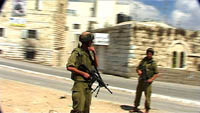
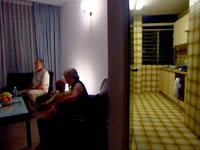
Eyal Sivan and Michel Khleifi’s documentary film Route
181, Fragments D’un Voyage en Palestine-Israel charts
the filmmakers’ journey along the 1947 UN demarcation
line for the partition plan for Palestine. They filmed
the people and places they encountered as they traveled
along this virtual border. Without making any judgments
they inserted themselves into the lived experience of
daily life as it takes place within these contested territories.
The film documents incidents that take place, events that
are unfolding or stories that are told by the people who
populate this land. This journey was edited down to a
7 hour duration making Route 181 an epic documentary in
a temporal sense.
“We filmed in such a way as to see things, men women,
and places as a sum total not yet revealed. Carried along
by chance meetings, together we listened to words, nature,
passions and disillusions. We tried to induce – first
in ourselves, then in the subjects we filmed – a loving
relationship with the everyday, one full of danger and
encounter with death. Men and women were provided with
the opportunity to speak – those who have forgotten the
official discourse, but who are nonetheless the basis
of the two societies, those on whose behalf the war is
waged.”
Mark Cullen 04
|